If you’re a consultant in Canada and you can attest to the fact that you are actively marketing your business but it’s not producing clients, here’s the direct answer: the problem is rarely effort; posting regularly on LinkedIn, trendy websites, or networking. It’s positioning. Specifically, it’s the absence of clear, credible “authority” communicated in a way that makes the right buyers stop and think, “That’s exactly who I need.”
That’s the gap. And it’s costing Canadian consultants more than they realize.
This article breaks down why marketing for consultants in Canada requires a fundamentally different approach, what buyers are actually doing before they ever contact you, and what you can do to fix the positioning problem that’s quietly removing you from consideration. Marketing for consultants in Canada often looks productive on the surface, like regular LinkedIn posts, polished websites, thoughtful networking, maybe even a webinar or two. But productivity doesn’t always translate into profitability. The reason many consultants feel frustrated with their marketing efforts isn’t a lack of action. It’s unclear positioning.
See, when your expertise isn’t framed with strategic precision, your marketing can generate visibility without generating revenue. And when authority isn’t clearly articulated, even experienced consultants can sound interchangeable in a crowded market.
What’s often happening instead is that authority isn’t clearly claimed or communicated.
The Real Reason Why Marketing for Consultants is Harder in Canada
We know the Canadian consulting market is not small. According to Statistics Canada, the management, scientific, and technical consulting services industry generated $39.9 billion in operating revenue in 2024, which is up 6.3% from the year before. There are over 76,000 management consulting businesses operating in Canada as of 2025 (IBISWorld).
That’s a crowded market. And in a crowded market, being good at what you do is not enough of a differentiator. Your buyers can’t see your work before they hire you. They can only see how clearly you communicate your value.
When that communication is vague, and most consultant marketing is vague, buyers move on without telling you why.
The issue has a name: The Authority Gap. It’s the distance between the expertise you actually have and the expertise your marketing makes legible to a buyer who doesn’t know you yet. Most consultants in Canada are operating with a significant Authority Gap, and their marketing is paying the price.
It goes without saying that products are visible, and many services are tangible. Consulting is neither. You’re selling thinking. Insight. Decision-making support. Transformation.
When someone buys a product, they can compare features. When someone hires a service provider, they can usually define deliverables— haircut, bookkeeping reports, or a renovated kitchen. But when someone hires a consultant, they’re buying:
- Your judgment
- Your ability to reduce risk
- Your ability to see what they can’t see
- Your capacity to guide higher-stakes decisions
That makes your value abstract. And, abstract value requires clearer positioning. If you don’t define the value clearly, the buyer will simplify it for you often in ways that reduce your perceived differentiation.
What Buyers Are Doing Before They Call You
Here’s where most consultants misunderstand the problem entirely. They assume marketing is about showing up more; more posting on social media, and more networking. But the data tells a very different story about how consulting buyers make decisions.
According to Forrester’s 2024 Buyers’ Journey Survey, 92% of B2B buyers start the purchase process with at least one vendor already in mind, and 41% have a single preferred vendor selected before formal evaluation even begins. As Forrester put it: “B2B buying today is a process of confirmation, not selection.”
Let that land. By the time a prospective client reaches out to you, they’ve already decided who they think they want. Your job is to be the name that was already on their mental shortlist before the call and before the proposal.
How do buyers build that shortlist? Research. According to 6sense’s 2025 Buyer Experience Report, 83% of B2B buyers still mostly or fully define their purchase requirements before speaking with any vendor, and the vendor contacted first wins the deal roughly 80% of the time.
And where does that research happen? Per a 2025 survey of B2B buyers, the top three sources for discovering new vendors are web search (33%), peer referrals (33%), and generative AI chatbots (32%) — essentially tied (Marketing Charts, 2025).
Read that last one again. Generative AI is now as influential as Google search and word-of-mouth in how buyers discover consultants.
As consultants in Canada, this is what we operate in. And if your positioning isn’t clear, specific, and authoritative, you won’t show up in any of those three channels effectively.
Why Consulting is Harder to Market Than Other Services
Products are visible. Many services are tangible. Right now, I bet you can point to a renovated kitchen, a set of financials, a delivered report.
Consulting is neither. You’re selling your intellectual insights and judgment. The ability to see what your client can’t see and guide them through decisions that carry real risk.
That abstraction is what creates a buyer problem. When the value is invisible before the engagement, buyers default to reducing their perceived risk. They compare based on:
- Familiarity (have I heard of this person before?)
- Referrals (did someone I trust recommend them?)
- Brand recognition (do they look credible at a glance?)
- Price (if I can’t evaluate quality, I’ll use cost as a proxy)
If your marketing for consulting services doesn’t answer the credibility question before the buyer asks it, you lose the evaluation before it starts. This is why vague statements like…
- “helping businesses grow,”
- “strategic solutions for leaders,”
- “driving results through innovation”
actively works against you. Not because it sounds bad, but because it sounds identical to every other consultant in the market. When you’re indistinguishable, buyers have no rational reason to choose you over a cheaper or better-known alternative.
So what happens? You get:
- Interesting conversations that don’t convert
- Prospects asking about price early
- Referrals that don’t turn into clients
- Long sales cycles
- Smaller project scopes
When your offer feels ambiguous, buyers protect themselves by negotiating, delaying, or choosing the safer option. That’s the hidden cost of unclear positioning.
The Canadian Market Makes The Authority Gap Worse
Consultants in Canada face specific structural pressures that amplify positioning problems.
Market concentration. The Big Four firms — Deloitte, McKinsey, Accenture, PwC, EY — hold an estimated 75% of the addressable enterprise consulting segment in Canada (Mordor Intelligence, 2025). Independent consultants and boutique firms are competing for the remaining market share with a fraction of the marketing budget and brand recognition.
Geographic fragmentation. Ontario captures 48.1% of consulting revenue; British Columbia 16.6%; Quebec 15.3% (Mordor Intelligence, 2025). If you’re a consultant outside the major hubs — or trying to attract clients across provincial lines — your marketing has to work harder to bridge geographic distance with credibility.
Cross-border competition. U.S.-based consulting firms with aggressive digital marketing and louder positioning are actively competing for Canadian business. If your positioning is unclear, a well-positioned American competitor with a polished website wins by default.
Relationship-driven buying cycles. Canadian business culture tends toward relationship-first, longer-cycle decision making. That’s an advantage — but only if your positioning is already doing the trust-building work before the relationship begins.
In this market, your positioning doesn’t just support your marketing. It is your marketing.

What Effective Marketing for Consultants Looks Like
Consultants who consistently attract higher-value clients and pride themselves on shorter sales cycles aren’t necessarily marketing more. They’ve closed their Authority Gap. Here’s what that looks like in practice:
They define a specific problem they are known for solving. Not “organizational development” but “helping mid-market Canadian professional services firms reduce leadership turnover during rapid growth.” Specificity signals expertise. Expertise signals reduced risk for the buyer.
They communicate outcomes in concrete terms. Not “I help companies scale” but “clients typically reduce their decision-making bottlenecks by 30-40% within the first 90 days.” Concrete outcomes make abstract value tangible.
They show up consistently with a clear point of view. Not tips and tricks content, but a consistent perspective on a specific problem; a perspective that is distinctly theirs. This is what builds familiarity before the first conversation.
Their website does the credibility work before a call is ever booked. The website of a well-positioned consultant answers three questions immediately: who they help, what specific problem they solve, and why they are the credible authority on that problem. If a visitor has to work to find those answers, the positioning is doing its job poorly.
They align their messaging with how buyers evaluate risk. Because consulting is a high-perceived-risk purchase, the most effective marketing for consultants addresses doubt before it arises through social proof, specific outcomes, clear methodology, and visible expertise.
As a result, buyers don’t have to work to understand their value. The conclusion feels obvious.
The Visibility Trap: Why More Activity Makes the Problem Worse
If your positioning is unclear, doing more marketing amplifies the confusion, not the results.
More LinkedIn posts with vague messaging means more vague impressions. More networking with an unclear value proposition means more “interesting conversations” that don’t convert. More content that sounds like every other consultant means more noise contributing to the market’s inability to differentiate you.
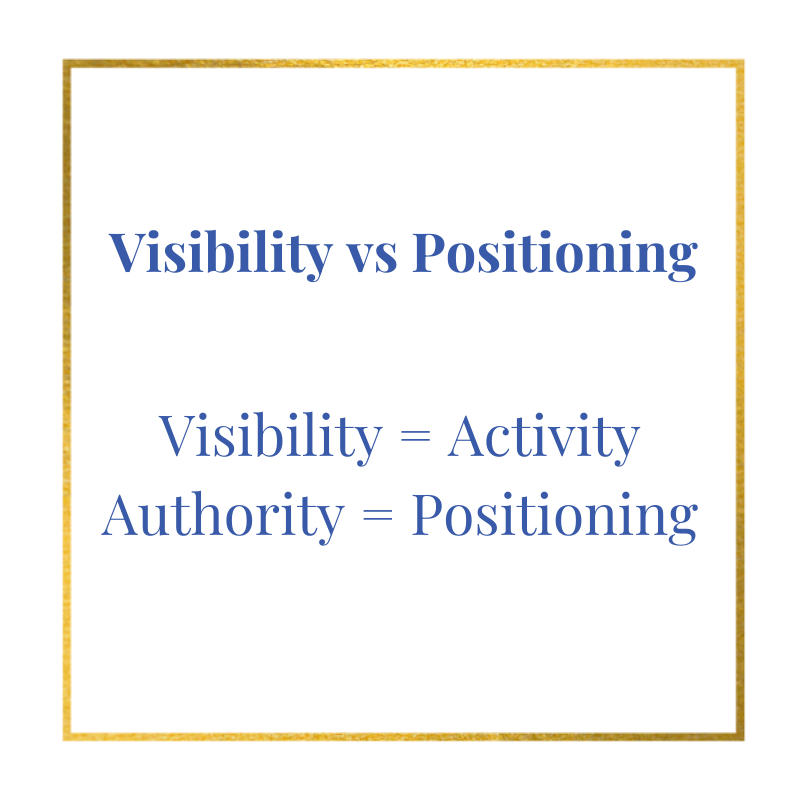
This is The Visibility Trap: the belief that more activity is the solution when the real problem is a lack of positioning precision.
The consultants stuck in this trap often describe their marketing as “exhausting but not working.” That’s because effort without strategic clarity produces volume without direction.
When positioning is sharp, the dynamic reverses. Content becomes easier to create because you know exactly what perspective to reinforce. Sales conversations shorten because buyers arrive already sold on your authority. Referrals convert more consistently because your positioning travels with the referral. Pricing discussions become less contentious because your value is no longer abstract.
Authority is what makes visibility pay off.
How to Start Closing Your Authority Gap
If your marketing for consulting services in Canada is producing activity but not clients, the first step is an honest audit of your positioning:
- The clarity test. Can someone read your website homepage and identify, within 10 seconds, who you help, what specific problem you solve, and what changes because of your involvement? If not, your positioning is unclear.
- The differentiation test. Could a competitor copy your homepage headline without it being wrong? If yes, your positioning is not specific enough.
- The outcome test. Does your website and content describe what changes for your client after working with you in concrete terms? Or do they describe what you do in process terms? Buyers buy outcomes, not processes.
- The authority test. Does your content demonstrate a specific, credible perspective on a specific problem? Or is it general advice that any consultant in your space could have written?
If you’re answering “not quite” to most of these, you’re not dealing with a marketing execution problem. You’re dealing with a positioning problem that marketing execution can’t fix.
Ready to See Where Your Positioning is Breaking Down?
If you’re a consultant in Canada and your marketing feels like it should be generating stronger traction by now, the problem is almost certainly not what you think it is.
A Website Diagnostic is the fastest way to identify exactly where your positioning, messaging, and authority signals are breaking down and what to fix first.
Nicole Gallant is a marketing strategist for consultants and service-based experts in Canada, with over 20 years of expertise connecting buyers to sellers across professional services markets. She is a Certified StoryBrand Guide and specializes in positioning, messaging, and authority-building for independent consultants and boutique firms.
Sources:
- Statistics Canada, The Daily — Consulting Services 2024, January 2026
- IBISWorld, Management Consulting in Canada, 2025
- Mordor Intelligence, Canada Management Consulting Services Market, 2026
- 6sense, B2B Buyer Experience Report 2025
- Forrester Research, B2B Marketing and Sales Are Too Late to Influence Decisive Buyers, 2024
- Marketing Charts, Most B2B Buyers Report Having Done Plenty of Research Before Engaging Vendors, December 2025