
A LinkedIn post caught my attention recently. The author made an argument that most businesses confuse positioning with messaging. He was stating that what people call positioning is really just framing, and that messaging, positioning and framing are three distinct disciplines that should never be conflated.
I understand the instinct to draw clean lines. After more than twenty years working at the intersection of sales and marketing, I’ve seen the damage that vague language does inside businesses.
But, frankly, the push to treat these three things as entirely separate disciplines creates a new kind of confusion and it’s showing up everywhere right now, because AI has made it very easy to sound fluent in positioning without actually understanding it.
That’s worth talking about.
The Problem Isn’t Positioning. It’s Who’s Talking About It.
Watching a less qualified person with a slicker AI-generated post outrank you in the feed, despite a fraction of your experience, feels like a gut-punch. You know your work is better. You know your thinking is deeper. And somehow that’s not what’s showing up first.
Here’s why. I’ve been talking about positioning with my clients for years. It was not mainstream language in the small business space five years ago. Most people were still talking about branding, or content strategy, or finding their “ideal client.” Positioning was something that lived in business school textbooks and enterprise-level strategy decks.
Now everyone is talking about it. And I’ll be direct: a significant number of those people are using AI to generate content about positioning without having any actual experience applying it to real sales situations with real buyers.
The terminology sounds right. The frameworks look polished. But something is missing, and your buyer, the sophisticated one you’re trying to reach, can feel that something is off.
This is also, not coincidentally, why so many conversations about positioning and messaging end up spinning in circles. When the people defining the terms haven’t had to prove those ideas in the field, the definitions get funky. Lines get drawn between concepts that work together in practice, not apart.
The Part That Actually Reminds Me of the Marketing vs. Sales Debate
The positioning-versus-framing-versus-messaging debate has the same energy as the old argument about whether marketing and sales are the same thing.
They’re not the same thing. Anyone who has sat across from a buyer (the one with arms folded waiting for you to hurry up so he can get on with his day) and had to earn a yes knows the difference. Marketing creates the conditions. Sales closes the loop. Confusing them costs you money.
But they also don’t work in isolation. Marketing without a sales brain behind it generates engagement without revenue. Sales without strong marketing behind it burns through the wrong leads. The distinction matters, and so does the integration.
Positioning, framing, and messaging work the same way. You can — and should — understand what each one is doing. But treating them as separate projects you execute in sequence is where businesses get into trouble.
So What Are They, Actually?
Positioning: The Strategic Decision
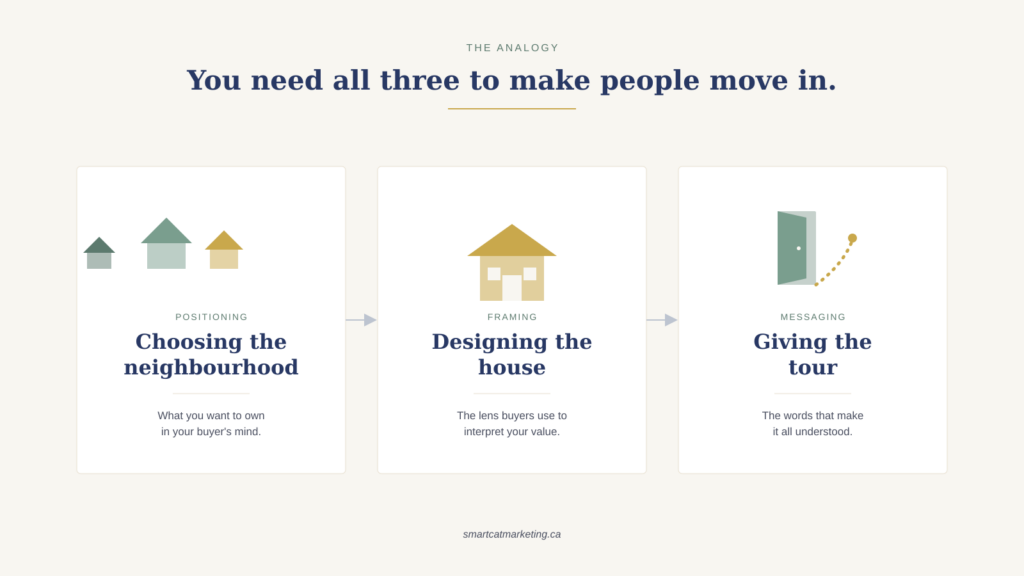
Positioning is a strategic choice about where you want to live in your buyer’s mind. It’s not a tagline. It’s not a value proposition. It’s a deliberate decision about what you want to own — a specific idea, a specific category, a specific perception.
Volvo didn’t accidentally become synonymous with safety. That was a positioning decision made decades ago and then reinforced in every product, every ad, every message, every year. The word “Volvo” lands differently in your brain than “Ferrari” does and that difference is entirely intentional.
For most consultants and service providers, positioning answers one core question: When a buyer in your market thinks of someone who does what you do, at the level you do it, for the clients you serve are they thinking of you? And more importantly, are they thinking of you first?
Framing: The Lens You Hand Your Buyer
Framing is how you influence the way a buyer interprets your value before they’ve made a decision.
Two consultants can offer the same deliverable. One calls it a strategy session. The other calls it a decision framework for your next stage of growth. The work might be identical. The perceived value is not, because the framing is different.
Framing is where buyer psychology lives. Buyers don’t evaluate your services in a vacuum. They evaluate them through whatever lens you’ve handed them. If you haven’t deliberately handed them a lens, they’ll use the most convenient one, which is usually whatever your closest competitor established first.
This is also where I see the most expensive mistakes in service-based businesses. Not in the messaging, not in the positioning, but in the framing. The service is excellent. The positioning is solid. But the buyer is being handed the wrong lens, and the value is getting lost in the interpretation.

Messaging: The Language That Makes It Land
Messaging is the actual words. It answers the practical questions your buyer is asking: What do you do? Who is it for? Why does it matter? What happens if I invest?
Clarity at this level is non-negotiable. If your buyer can’t understand what you do in the time it takes to read your homepage headline, you’ve lost them. Not because they’re unsophisticated because they’re busy, and it’s your job to make it easy.
But here’s the limitation: clarity is not the same as differentiation. You can write perfectly clear messaging and still sound exactly like everyone else in your category. That’s not a messaging problem – it’s a positioning and framing problem that messaging can’t fix on its own.
Positioning Is the Neighbourhood. Framing Is the House. Messaging Is the Tour.
A beautiful house in the wrong neighbourhood creates confusion. The perfect location with a poorly designed house won’t attract serious buyers. And even if the neighbourhood is right and the house is stunning, someone still needs to open the front door and show people around.
You don’t build those in any order you like and call it strategy. You make them work together or you waste the investment in each one.
Why Rewriting Your Website Won’t Fix a Positioning Problem
Most consultants, coaches, and service providers who come to me aren’t only dealing with a messaging problem. They think they are, because the symptoms show up in their words; on their website, in their proposals, in how they explain what they do on a discovery call.
But the actual issue is usually upstream. Either their positioning is unclear — they haven’t made the strategic decision about what they want to own in the buyer’s mind — or their framing is off, and buyers are interpreting their value through the wrong lens.
Rewriting your website copy won’t fix a framing problem. Updating your bio won’t fix a positioning problem. Those are messaging solutions applied to the wrong layer. And, it’s why so many businesses invest in website refreshes, rebrand projects, and content strategies and still end up in the same place.
The question to ask before you touch a single word on your website: Do I have a messaging problem, a framing problem, or a positioning problem? Because the answer determines everything — including whether a copywriter, a strategist, or a complete rethink of your market category is what’s actually needed.
The Bottom Line
The author of this LinkedIn post, which got me all fired up, is not wrong that the distinction matters; he’s wrong that they should stay separate. Yes, positioning, framing, and messaging are different things. Understanding the distinction makes you a more effective communicator.
But the goal is not to separate them into three distinct projects you hand to three different consultants. The goal is to align them. Your positioning shapes your framing. Your framing informs your messaging. When all three are working from the same strategic foundation, the result isn’t just clarity. It’s the kind of resonance that makes your ideal buyer feel like they finally found what they were looking for.
If you’re not sure where the disconnect is in your own business, positioning, framing, or messaging, that’s usually not something you can see from the inside. You’re too close to it.
That’s the exact problem I solve. If you want a second set of eyes, here’s where to start.